Journal
Hooded eyes: brow lift or eyelid surgery? A mix up shown on one face
Hooded eyes can come from lid skin or a low brow. See both fixes simulated on one face and learn how to tell which question to ask.
 Claire Winslow
Hooded eyes are often described as one thing, yet two different structures can create the look. In one case, extra skin on the upper lid folds down and covers the lash line. In the other, the brow sits low and pushes the lid area down. The treatments differ, so the first job is working out which one you are dealing with.
This guide is for readers who have searched for both options and are not sure which to bring to a consultation. It explains how to look at your own eyes, shows both ideas simulated on one face, and ends with questions for a specialist.
A quick note on health. If a lid has dropped suddenly, or one eye looks much lower than the other over days or weeks, see a doctor promptly. That is a medical question, not a cosmetic one.
1. Find your starting point
Stand in front of a mirror in even light and look straight ahead with a relaxed face. Do not tilt your chin up. Ask three questions.
Where does the brow sit? A brow that sits level with or just above the bony ridge of the eye socket is in a typical position. A brow that sits low, close to the lid, suggests the brow could be part of the answer.
How much lid can you see? Count the visible lid between the lash line and the brow. A narrow band with skin folding over the lashes points toward lid skin.
What changes when you lift the brow with a finger? Place a finger lightly on the brow and raise it a little. If the lid opens up and the hood disappears, the brow is a big part of the picture. If the fold barely changes, excess lid skin is more likely.
Our model has thick, dark, fairly straight brows, large green eyes and a quiet upper lid with a soft fold. That makes her a useful example, because both explanations could be raised at a consultation.
2. The eyelid option
Upper eyelid surgery, called blepharoplasty, addresses the lid itself. A specialist can remove or reposition excess skin, and sometimes a small amount of fat, so more of the lid shows and the lash line becomes visible.
In the simulation below, the brows stay exactly where they are. Only the upper lid changes: more of the lid is visible, the lash line shows clearly and the fold sits cleaner above the lashes.
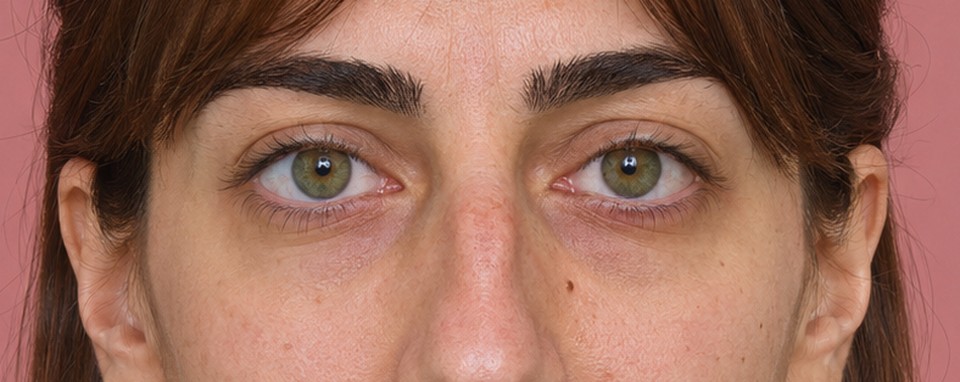
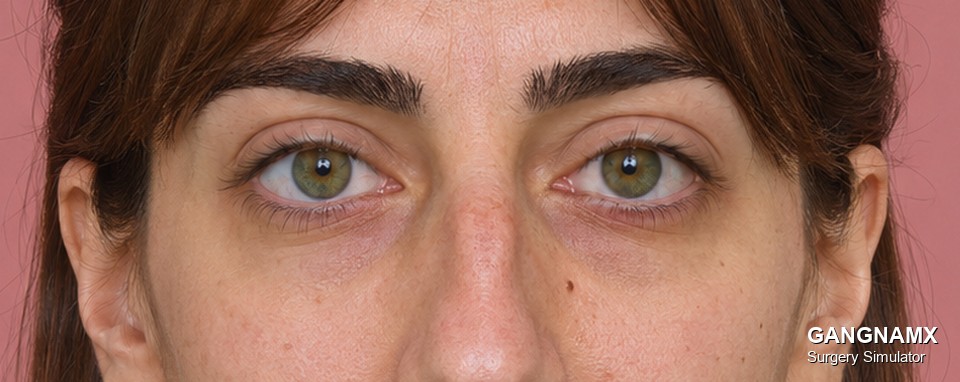
Notice what stays: the eye shape, the green iris and the heavy brows. The change is a clearly more open lid, not a different face.
3. The brow option
A brow lift raises the brow, or in a lighter version just its outer part. Lifting the tail opens the area above the eye and can reduce the sense that the lid is being pressed down. Because the brow and the lid share the same space, the two can look alike in a photo even though they are different structures.
In this simulation, the lids are left alone. The brows are lifted by a clear margin, keeping their natural thickness and arch.
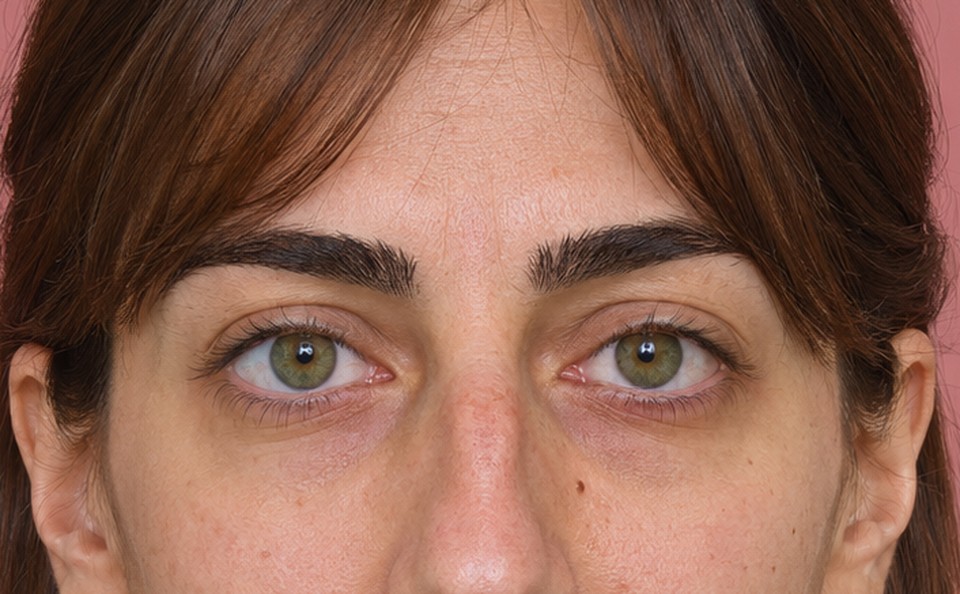
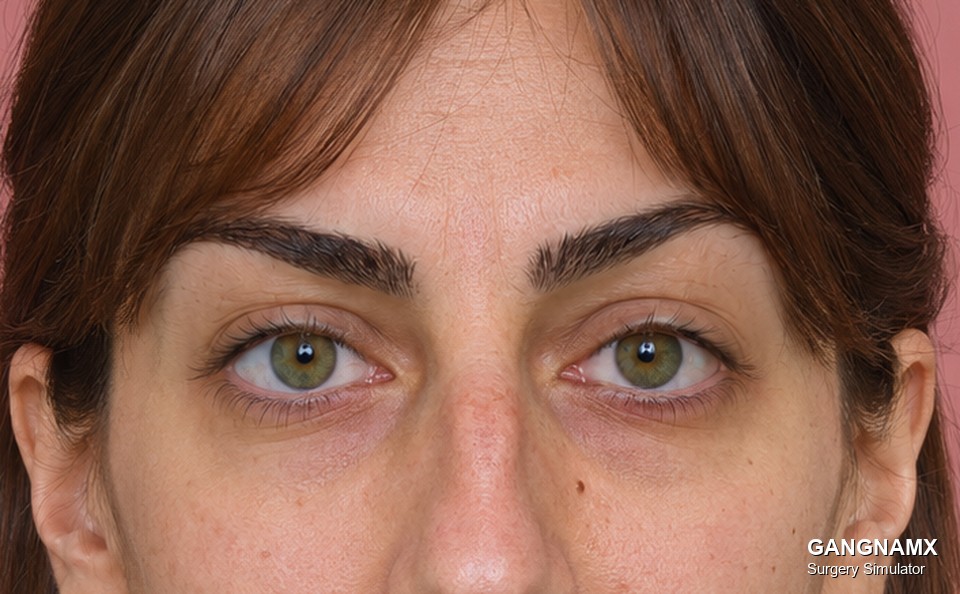
Here the eyes themselves are untouched, yet the brows sit visibly higher and the area above the eyes looks more open. Compare this with the previous pair and you can see that the two ideas reach a similar feeling through different routes.
4. Compare the options and the trade offs
No single answer fits everyone, but you can compare in a structured way.
What it changes. Lid surgery changes the amount of lid skin. A brow lift changes the position of the brow. Some faces benefit from one, some from both, and some from neither.
What it can affect. Brow lifts can change the expression of the upper face and can make a face look surprised if overdone. Lid surgery can change how the brow and lid relate if too much skin is removed. In both cases, restraint matters.
Interaction. If the brow is low, lid surgery on its own can sometimes pull the brow lower still. A specialist will usually assess for this before planning, and it is a major reason to look at both options together.
Recovery and scars. Scar position, bruising and swelling differ between approaches. Ask for the specific details of the technique proposed and what they mean for you.
Fit with your features. Strong, dark brows are part of this model’s look. A plan that respects that, and refines rather than erases it, is more likely to feel like her.
Photos can mislead in both directions. A chin raised for the camera lifts the brow area and hides the hood. A chin tucked down does the opposite. Take your reference photos with a level head and relaxed forehead, because tension in the frown muscles can fake a brow position you do not actually have. Bring a photo in which you are not trying to look awake.
Age and skin play a part. Lid skin loosens gradually, and the brow tends to settle lower over the years. A younger face with a heavy fold may have a different cause from an older one, and a specialist may weigh these differently.
None of this replaces an examination. Brow position, skin thickness and muscle strength all vary, and a specialist who sees you in person can tell you which route, if any, is suitable. A simulation shows shape only.
5. Questions to bring
- Cause: Is my hooded look from lid skin, the brow, or both?
- Test: What happens to my lids when you hold my brows in a raised position?
- Alternatives: Are there smaller or non surgical options worth discussing first?
- Balance: How would each option change the look of my brows and expression?
- Risks and follow up: What risks apply, and what does follow up involve?
Seeing both versions on your own photo, side by side, is a calm way to learn which question applies to you.
Simulation images by GangnamX.
 Plastic Surgery SimulatorEvery option, first.EyesNoseJawlineStart simulating