Journal
Why your nostrils show from below in photos: angle, tip rotation and your phone
Nostrils that show in low angle photos are mostly about the camera. Learn how phone height and tip rotation interact, with a labeled simulation.
 Claire Winslow
If your nostrils look large or prominent in photos taken from below, you are describing one of the most common phone camera effects. Selfies, video calls on a laptop set low, and a phone held at chest height all look up at the nose, and the nostrils are the part that turns toward the lens.
This guide separates three causes: angle, tip rotation and the phone you hold. It matters because only one of them is about your nose. Sorting them in order can save you from changing the wrong thing, and it gives you something concrete to bring to a specialist if the question remains.
1. Start with the camera, not your nose
Hold your phone below your chin, look into the lens, and the nose changes in three ways. The camera sees up into the nostrils. The tip appears to point forward and up. The chin and jaw line shorten, which makes the nose seem larger relative to the lower face.
A few quick checks tell you how much of this is the angle:
- Raise the phone to eye level. If the nostril show drops sharply, the camera was the main cause.
- Step back and zoom. A 2x zoom from farther away flattens perspective, so the nose stops growing toward the lens.
- Keep the chin level. Lifting the chin turns the nostrils toward the lens and tips the whole nose upward.
- Use the rear camera. Many front cameras use a wide lens that exaggerates what is closest.
Take the same photo three ways, low, eye level, and from a short distance with zoom. Put them next to each other. If the nostrils nearly disappear in the third, your nose is behaving like a normal nose under a hard angle.
2. When tip rotation is part of the answer
Tip rotation describes how far the tip of the nose turns up or down. The angle between the base of the nose and the upper lip is often discussed in this context. A tip that turns up more shows more nostril from below. A tip that turns down shows less nostril from below, but may look longer or droopier from the side.
This is a trade off, not a fault. A slightly upturned tip is a feature many people like. Others prefer a straighter line. Neither is correct for every face, and the right amount depends on the length of the nose, the lip, and the chin.
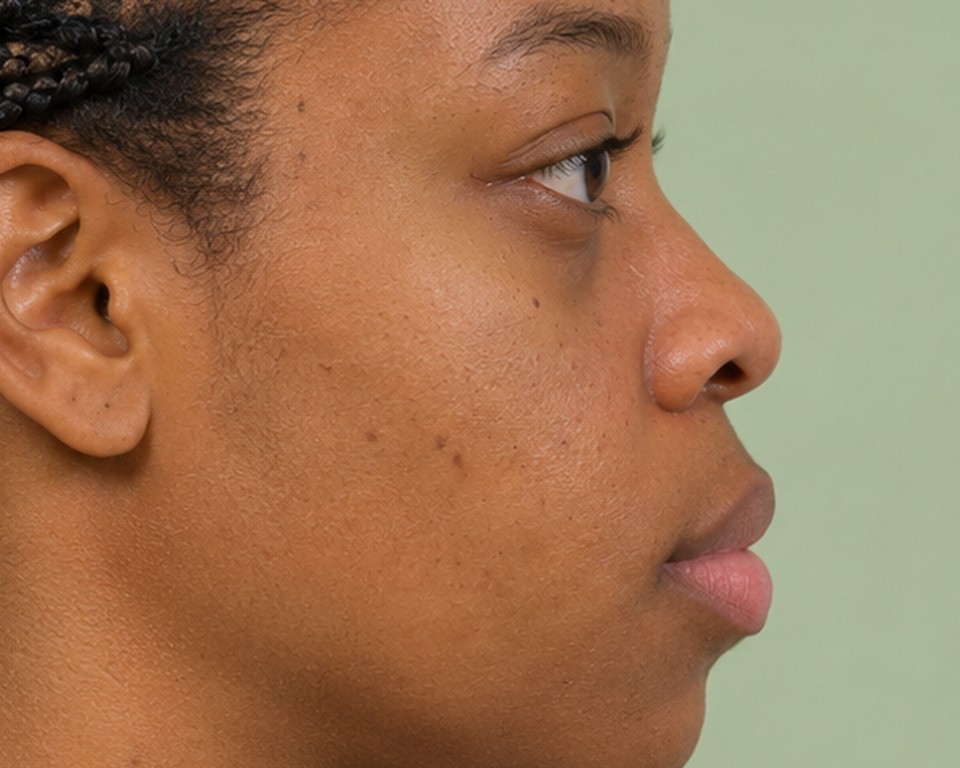
Our model has a soft, rounded nose tip with a gentle upward turn. In a straight on photo it looks calm. In a low angle shot, the same tip will show more nostril, simply because the rotation tips the openings toward the lens.
3. A labeled example on one face
The first comparison shows the side view and a visible increase in how far the tip turns up. It makes the openings more visible from below, which is the effect many people want to reduce.
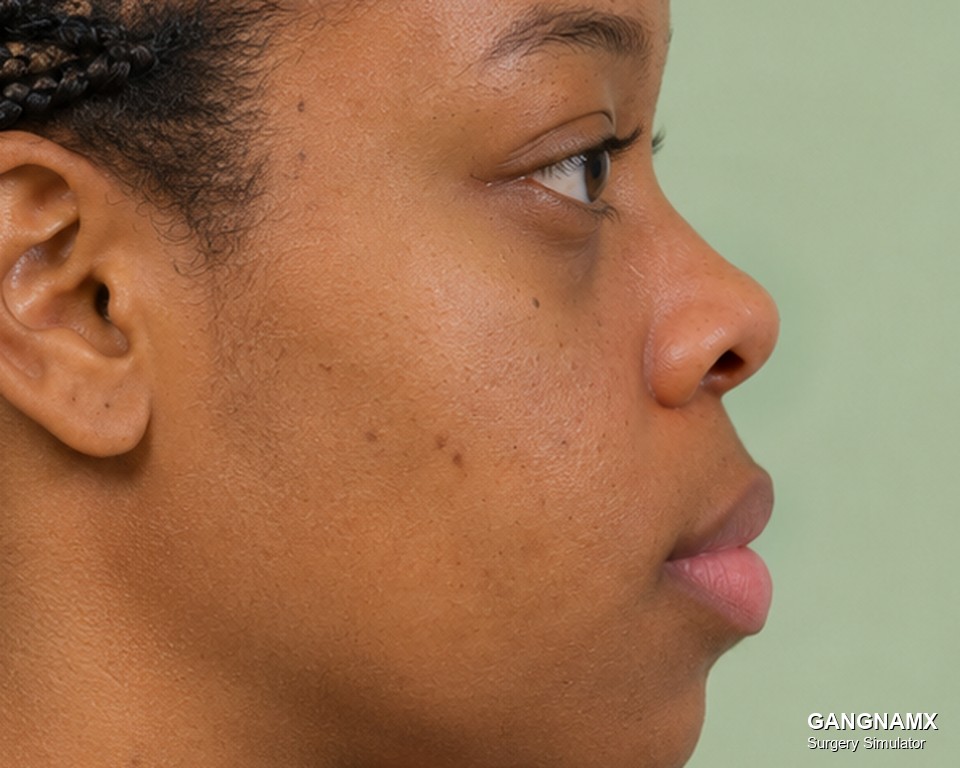
The second comparison goes the other way. The tip is lowered a few degrees, so the nose points slightly more toward the front and the openings face the lens less in a low angle photo.
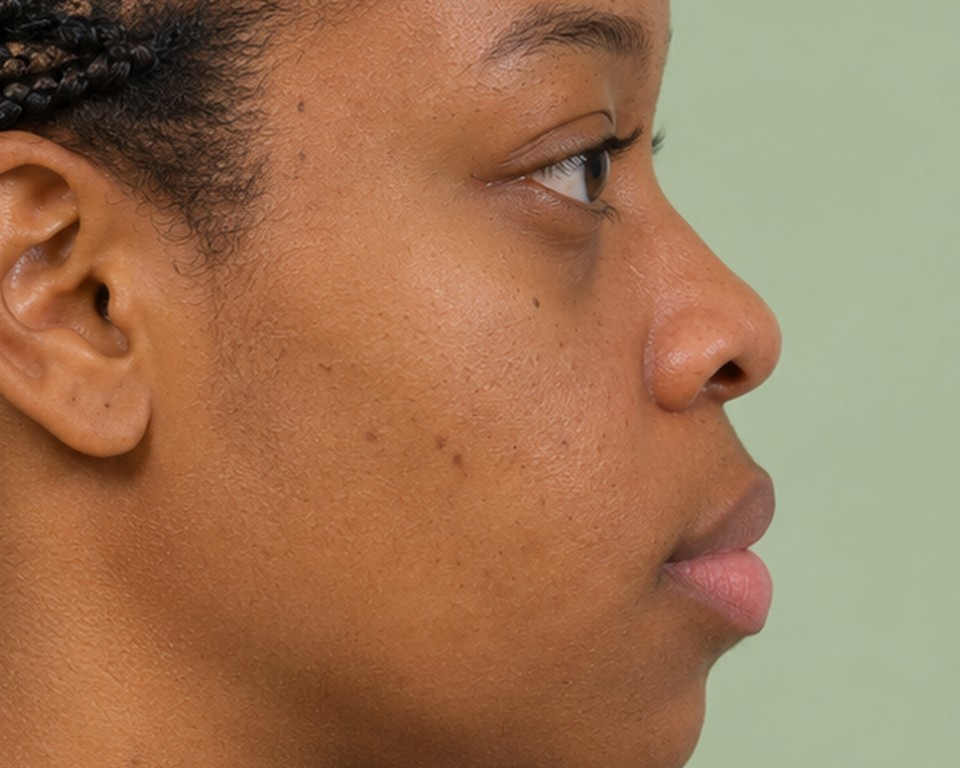
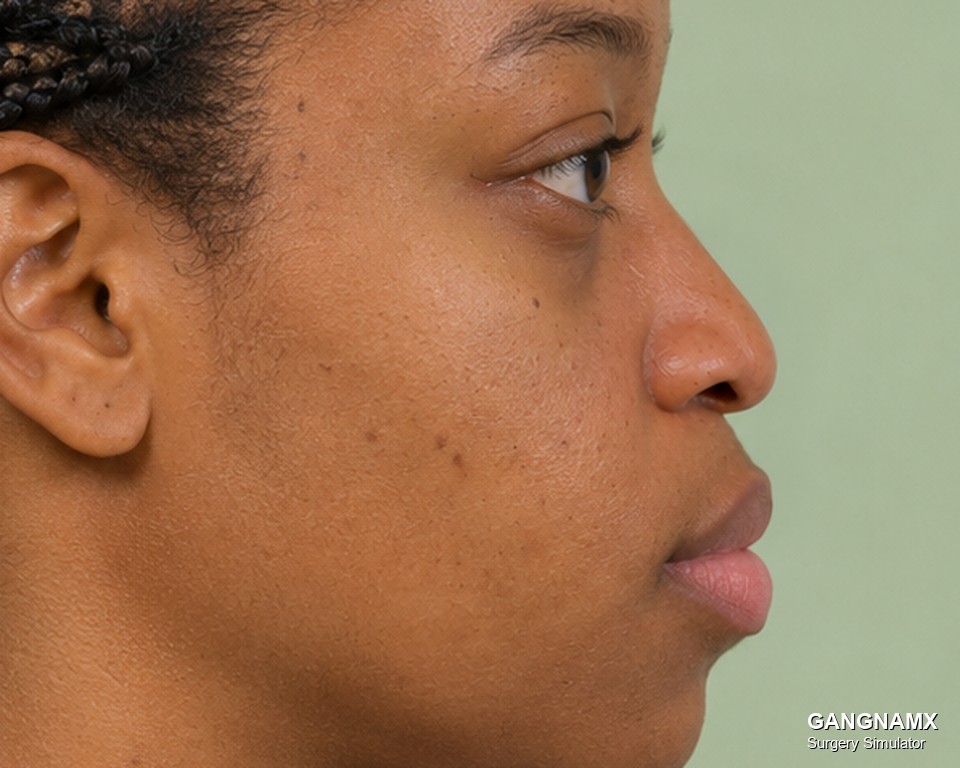
Look at both pairs and ask two questions. Which tip angle still suits the lip and the chin below it? Which one looks like her? The answer is rarely the most dramatic option. A change of a few degrees is already visible, and our model also has a chin that sits slightly back, which affects how any tip angle reads from the side.
4. Compare the options and uncertainties
There are several routes, and the quietest is usually first.
Change the photo habit. Raise the phone, step back, zoom, and keep the chin level. It costs nothing and is reversible every time you press the shutter.
Do nothing. Some nostril show is normal in any low angle photo. If your eye level photos look fine, there may be nothing to solve.
Adjust the tip. If the nostrils also stand out at eye level, a specialist can talk about tip rotation and the shape of the nostril rim. These are small structures, and small shifts change the look. Heritage matters here: a rounder tip and fuller nostril are part of many faces, and the goal is a balanced refinement, not a template.
Consider the whole profile. If the chin sits back or the lip is short, the nose may only look prominent because of what sits around it. A plan that looks at nose and chin together can be more convincing than one that fixes the nose alone.
Know the vocabulary. Three words help in a consultation. The columella is the strip of skin between the nostrils. The alar rim is the edge of each nostril. Nostril show is how much of the opening is visible from the front. Using these terms, and a photo taken at eye level, lets a specialist see what you mean without guessing from a selfie.
Mind the phone you hold. Different phones and apps use different lenses and automatic beauty settings. Turn off any filter or face smoothing when you take reference photos, since these can change the shape of the nose and the look of the nostrils.
On uncertainty: tip shape depends on cartilage, skin thickness and how tissue heals. A simulation shows an idea, not a guarantee of how a real nose will settle.
If you ever have trouble breathing through your nose, mention it to a doctor. That is a function question and deserves its own assessment.
5. Questions to bring
- Angle check: At eye level, with a normal distance, do my nostrils still look prominent?
- Tip: What is my current tip rotation, and what range looks natural with my lip and chin?
- Alternatives: Are there options short of surgery worth discussing first?
- Keeping my features: How would we refine the tip while keeping my overall look?
- Risks and follow up: What risks apply, and what does recovery involve?
Seeing a few degrees of rotation on your own photo, in side view and from a realistic distance, is a simple way to find out whether this is about the camera or the nose.
Simulation images by GangnamX.
 Plastic Surgery SimulatorEvery option, first.EyesNoseJawlineStart simulating