Journal
Steph Curry's Strong Chin, Simulated in Profile
A strong chin shows in profile. See two chin options, a gentle step forward and a firmer one, with the gentle step simulated at 90 degrees.
 Claire Winslow
A strong chin is mostly a profile fact. From the front it is hard to tell how far forward the chin sits, which is why people who admire a firm chin on an athlete often cannot say what they are actually admiring until they see the face side on.
Steph Curry has been all over the sports and style feeds this week, and his lower face comes up often because it reads firm and balanced from the side. We describe that appearance only: a chin that sits well forward under the lower lip, with a clear line from lip to chin point. This guide does not guess how any face reached that shape, and our model is not being made into him.
Look at the profile before you pick an option
Turn your head to a true 90 degree view, or ask someone to take a photo with a level head. Then check three simple relationships. Where is the lower lip? Where does the chin point sit in relation to it? How long is the chin? From the lower lip to the bottom point. How crisp is the angle under the chin? A soft angle can make a good chin look weaker.
Our model is a man in his thirties with short dark hair, a clear nose and a solid, slightly full lower face. In profile his chin is short and sits clearly behind the lower lip, with a soft point and a little fullness under it. Nothing is wrong with that. It is a very common arrangement, and it means a change will be easy to see without altering his character.
Option A: a gentle step forward
The simplest idea is to bring the chin forward so the point lines up with the lower lip. In practice this is the territory of chin implants or filler, which add projection to the front of the chin without moving bone.
In the picture, only the chin moves. His nose, lips, jaw line and neck stay as they are.
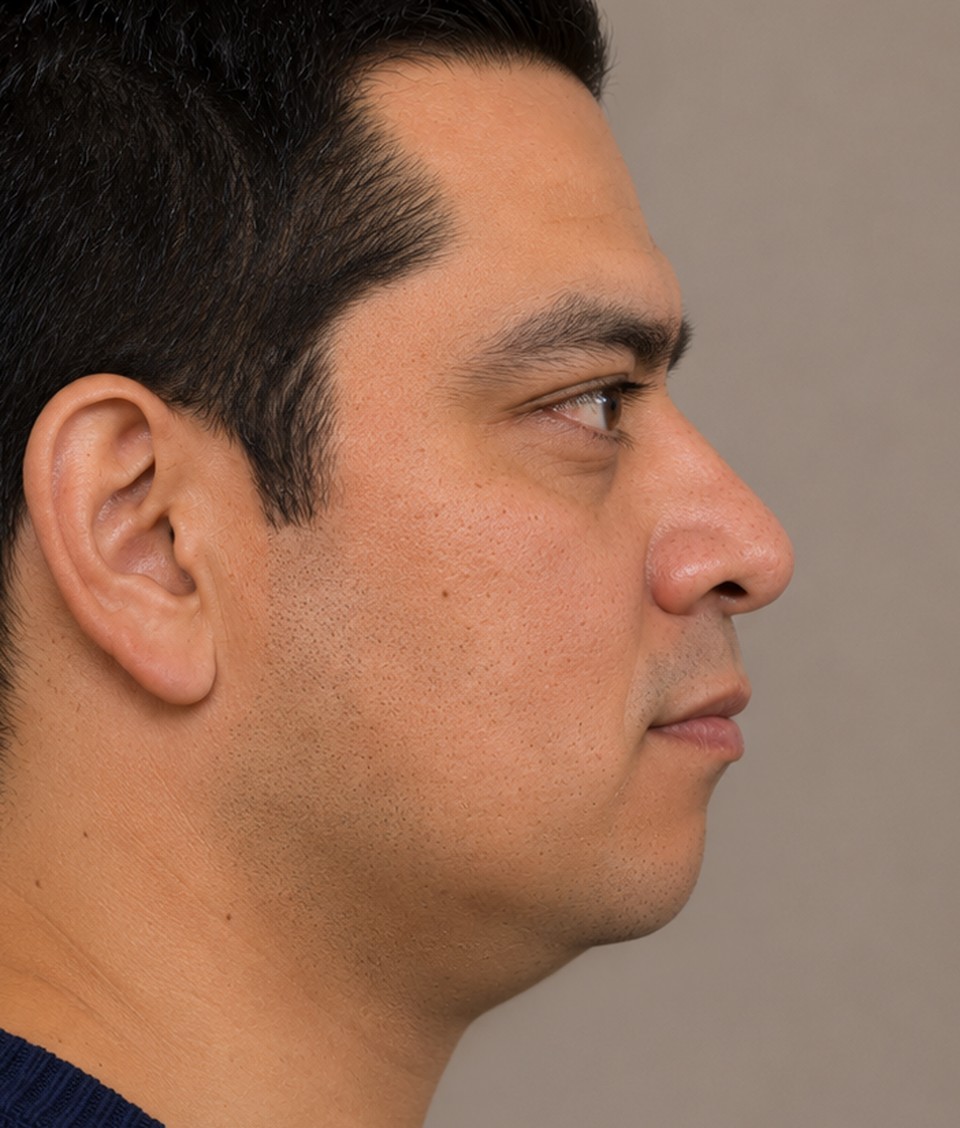
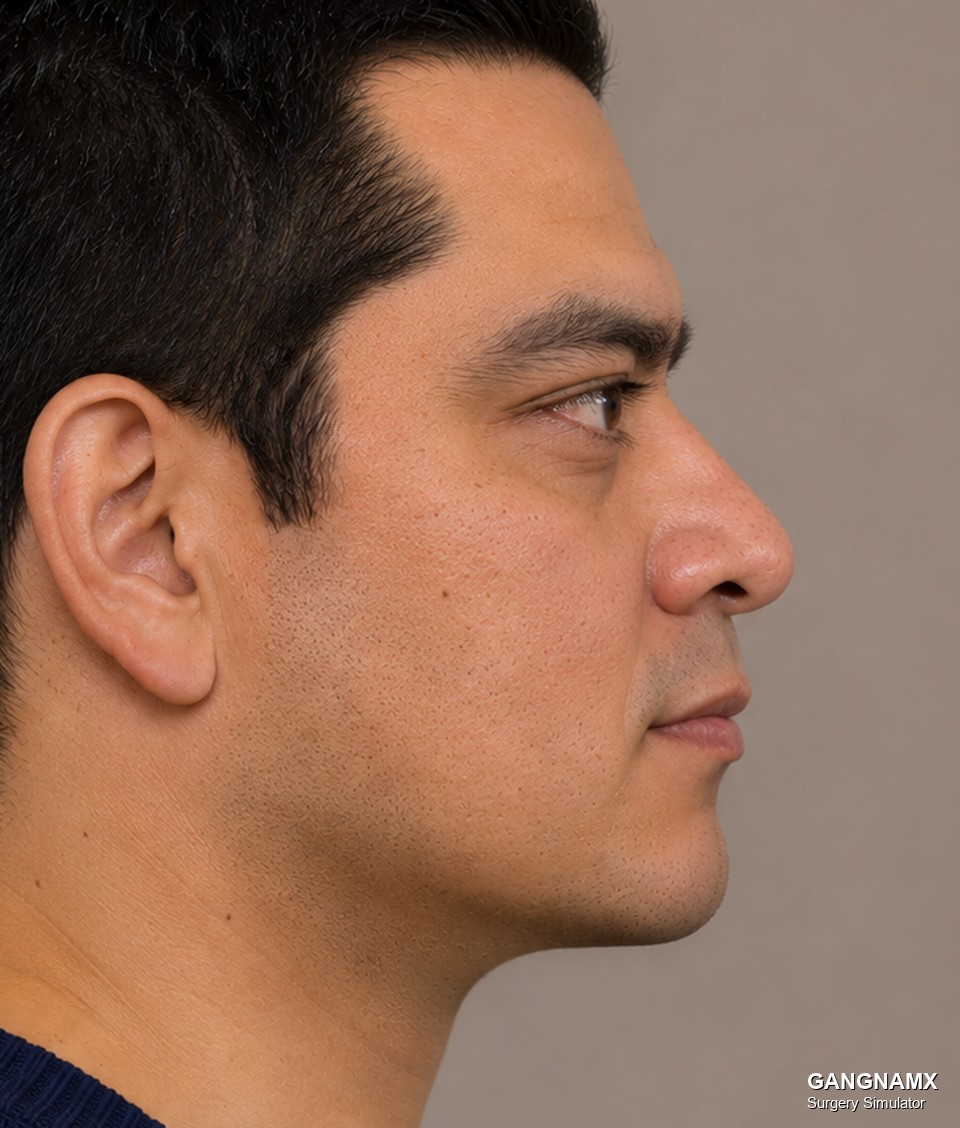
What the eye notices first is the chin point moving forward, so the line from the lip down to the chin becomes straighter and the soft area under the chin looks tighter. The face looks more settled in profile, and the lower third feels in proportion with the nose above it.
Option B: further forward, with a firmer point
The second idea goes a step further. Instead of a soft, rounded gain, the chin comes forward by a larger amount and the point is a little more defined. This kind of change is often discussed with a surgeon in terms of moving the chin bone itself, sometimes called a sliding genioplasty, because that approach can adjust more than one direction at once.
Bigger is not automatically better. A chin that moves too far can look attached and can change how the lips and neck relate. We did not simulate this one, because at this size it would be hard to tell apart from Option A in a picture. It is a larger step than Option A, and the amount is something to settle with a surgeon.
The gentle version improves alignment. This one brings the chin a bit further and gives it a little more presence, the kind you notice in the room as well as the photo.
Why the chin changes how the nose reads
Readers often ask about the nose when they really mean the chin. The nose and chin are judged against each other in profile, so a chin that sits back can make an average nose look larger than it is. Pulling the chin forward, even modestly, can change that impression without the nose changing at all.
You can see this effect in our model. His nose has a clear, straight line and a tip with a little projection. In the original side view, the nose clearly leads the face. In the simulated version the lower face catches up, and the nose looks calmer. That is a useful point to carry into a consultation, because it shows that the chin question and the nose question are connected.
There is also a plain limit to remember. A simulation moves a picture. A real chin sits on a jaw, a bite and a neck, and those decide how far a result can go. That is why a specialist will usually ask to see you from the side, look at how your teeth meet, and talk through what is realistic before any option is chosen.
What separates the two in practice
The two options differ in degree, and the real world differences go beyond the amount of projection.
- Material. One adds something to the front of the bone. The other repositions the bone. Ask which is proposed and why.
- Adjustability. Moving bone allows changes in more than one direction. A smaller addition is simpler. Both involve trade offs.
- Recovery. Swelling, numbness and the time off differ. Ask for specifics about the plan for your face.
- Neck and jaw. A chin brought forward changes the line under it. Check how your neck and jaw line would look afterward.
- When it is not about the chin. Some profiles that look weak are really about the bite or the position of the jaw. A specialist will check that before anything else.
The one line verdict
A strong chin is a relationship, not a size, so judge any option by how it lines up with your lip and nose in a true side view.
Simulation images by GangnamX.
 Plastic Surgery SimulatorEvery option, first.EyesNoseJawlineStart simulating