Journal
TXT Huening Kai's Eyes for Men: Every Crease Option, Simulated
TXT Huening Kai's soft, open eye look, moved toward on one man: a tapered crease and a parallel crease, each simulated alone.
 Claire Winslow
Three questions decide almost every crease conversation: where does the line start, how far above the lashes does it sit, and how curved is it? Answer those and you have described the option. Skip them and a photo reference becomes a guess.
TXT’s Huening Kai is a handy reference this week because his eyes look soft, open and easy rather than sharp or styled. We describe appearance only: a calm lid with a gentle fold and a relaxed brow. This guide does not say how any face reached its shape, and our model is not being turned into him. It shows how two separate crease options move one ordinary face toward that kind of softness.
Three crease questions that sort every option
A crease is the fold of skin that forms above the lash line when the eye is open. Plain language helps here.
- Tapered means the fold starts near the inner corner and narrows, hugging the lashes as it travels outward.
- Parallel means the fold keeps an even gap from the lashes along its whole length.
- Brow shape is not a crease at all, but it frames the lid so strongly that it belongs in the same conversation. We did not simulate it here.
Men who ask about these options usually want to look rested and clear, not made up. That goal favors restraint, and it is why each change below is shown alone.
Our model’s starting point
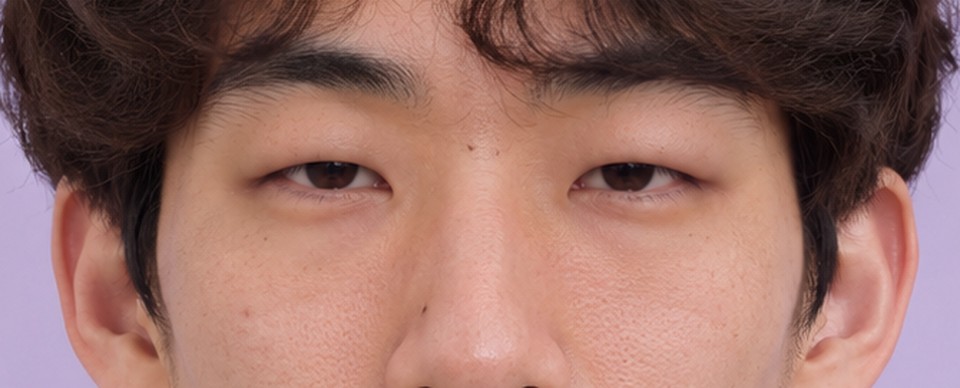
Our model is a Korean American man of about 24, with wavy dark brown hair, a long face and straight, fairly flat brows. His eyes are clearly monolids with heavy, slightly puffy upper lids and no visible fold, so the lid reads as one smooth surface in most photos. There is no shadow above the lashes, which makes the eyes look small and tired from the front.
That plain surface is useful. A new line will be easy to see, easy to judge and easy to compare with the next option.
Option 1: a tapered crease
The tapered option draws a fine line that begins near the inner corner and follows the lash line closely. It gives the lid a clean edge without adding much visible lid skin. In the picture the line is clearly visible, and the eye looks more defined, much wider open and brighter.
Brows and the skin under the eye stay as they are. The lid lifts a little with the fold, so the eyes open clearly wider.
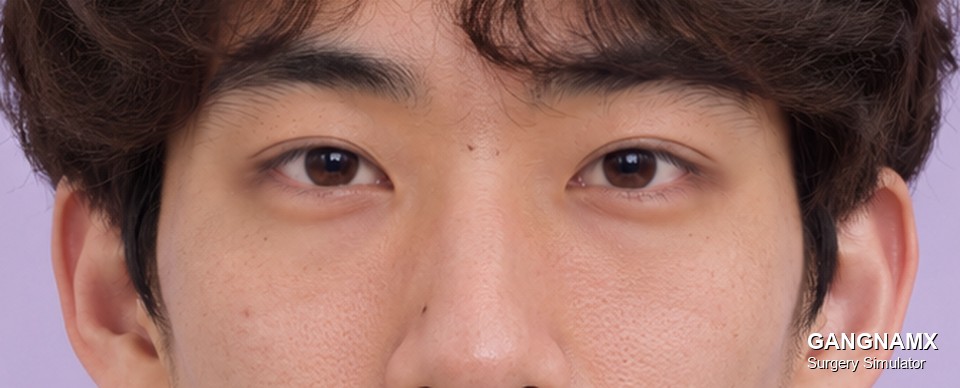
Look at the lid edge first. The fold now catches a little shadow, the eye has a finished outline, and more iris shows. His face reads as the same man, only more put together.
Option 2: a parallel crease
The parallel option keeps a small, even strip of lid visible between the lashes and the fold, all the way across. That strip is what makes an eye feel open and gentle. It is also more noticeable than the tapered line, so size matters. Too wide and it looks drawn on a man’s face.
In the next picture the line is clear but still sized for a man’s face. The brows and skin stay the same, and the eyes open clearly wider.
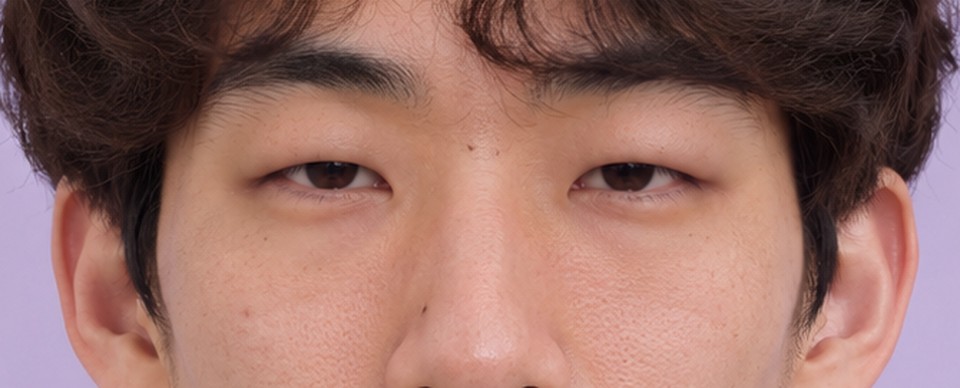
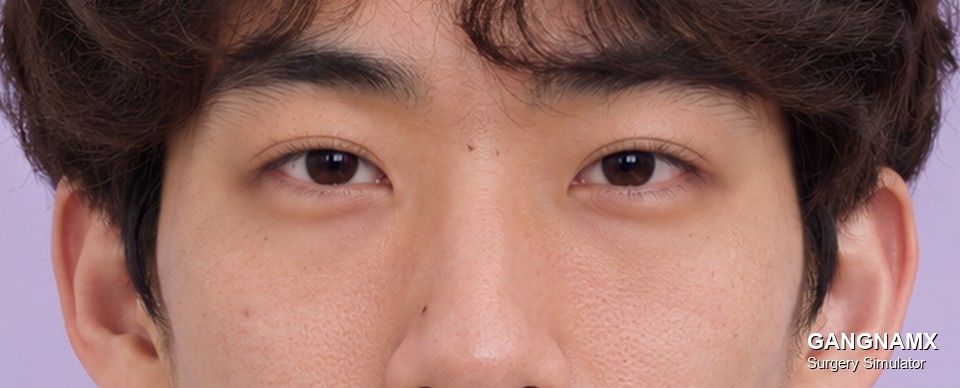
The eye now has a visible band of lid, more iris showing and a softer, friendlier expression. This is the version closer to the relaxed openness fans describe, though it is also the one that shows most when you look straight at him.
Reading the two together
| Option | What moves | What stays | Best noticed |
|---|---|---|---|
| Tapered crease | Lid edge near the inner corner | Brows, lid depth | Up close |
| Parallel crease | Visible band of lid | Brows, eye shape | Straight on |
Ask the same three things of each picture. Would a colleague notice it? Does it suit your brow? Would you still like it in ten years, as lid skin loosens? In these pictures both lines are clearly visible and both open the eyes. The tapered line is the lighter of the two and tends to wear well. The parallel line is the more expressive.
A simulation shows shape only. Lid thickness, skin and anatomy vary, and a specialist who examines you can tell you what is realistic.
One line verdict
If you want the softness without anyone asking what changed, begin with the tapered crease, then look at the parallel crease last.
Simulation images by GangnamX.
 Plastic Surgery SimulatorEvery option, first.EyesNoseJawlineStart simulating